

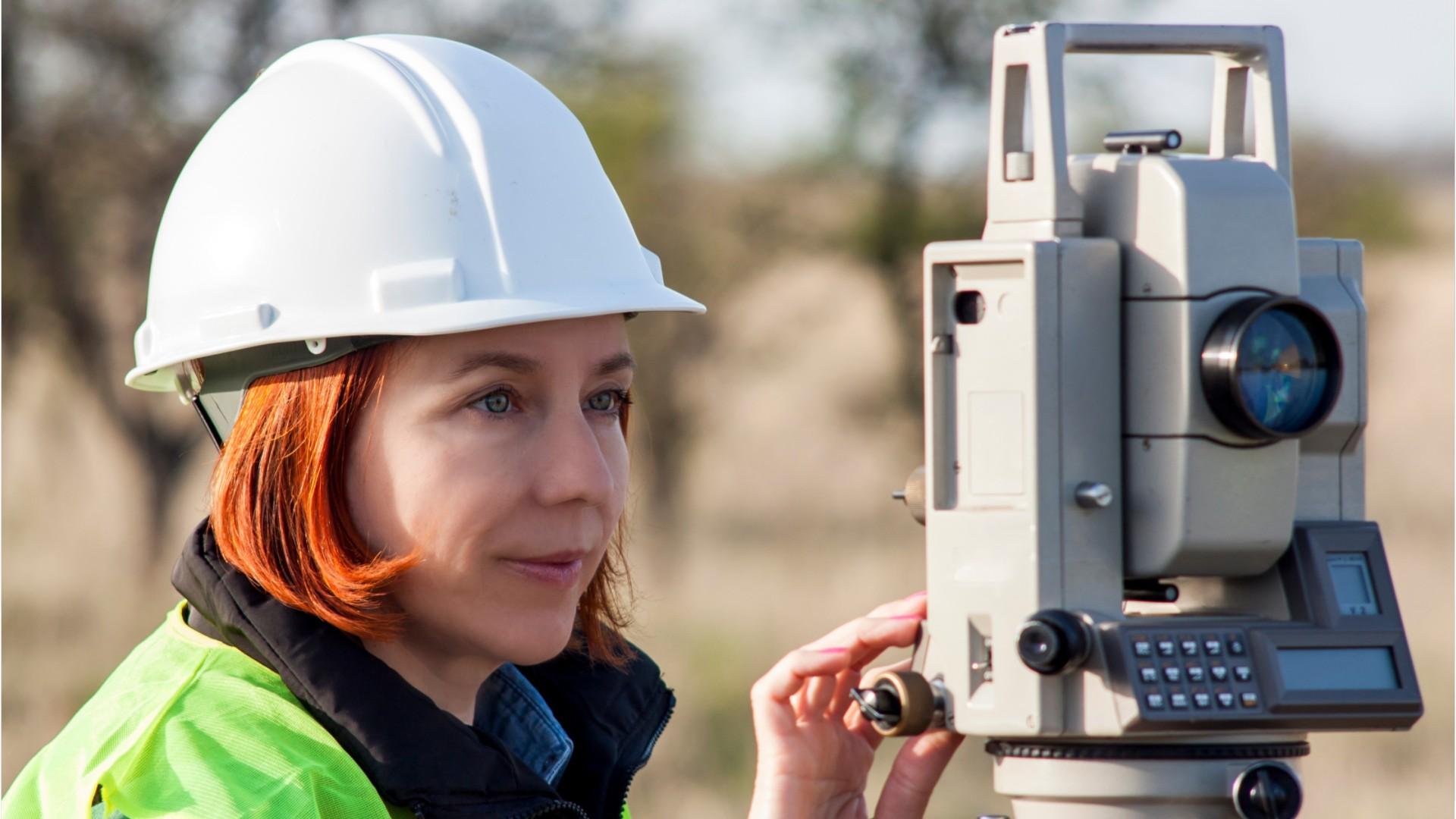
Surveyors
Make exact measurements and determine property boundaries. Provide data relevant to the shape, contour, gravitation, location, elevation, or dimension of land or land features on or near the earth's surface for engineering, mapmaking, mining, land evaluation, construction, and other purposes.
What is this job like?
- Train assistants and helpers, and direct their work in such activities as performing surveys or drafting maps.
- Calculate heights, depths, relative positions, property lines, and other characteristics of terrain.
- Prepare, or supervise preparation of, all data, charts, plots, maps, records, and documents related to surveys.
- Train assistants and helpers, and direct their work in such activities as performing surveys or drafting maps.
- Analyze survey objectives and specifications to prepare survey proposals or to direct others in survey proposal preparation.
- Survey bodies of water to determine navigable channels and to secure data for construction of breakwaters, piers, and other marine structures.
- Write descriptions of property boundary surveys for use in deeds, leases, or other legal documents.
- Direct or conduct surveys to establish legal boundaries for properties, based on legal deeds and titles.
- Plan and conduct ground surveys designed to establish baselines, elevations, and other geodetic measurements.
- Verify the accuracy of survey data, including measurements and calculations conducted at survey sites.
- Develop criteria for survey methods and procedures.
- Testify as an expert witness in court cases on land survey issues, such as property boundaries.
- Determine specifications for equipment to be used for aerial photography, as well as altitudes from which to photograph terrain.
- Prepare and maintain sketches, maps, reports, and legal descriptions of surveys to describe, certify, and assume liability for work performed.
- Adjust surveying instruments to maintain their accuracy.
- Locate and mark sites selected for geophysical prospecting activities, such as efforts to locate petroleum or other mineral products.
- Record the results of surveys, including the shape, contour, location, elevation, and dimensions of land or land features.
- Compute geodetic measurements and interpret survey data to determine positions, shapes, and elevations of geomorphic and topographic features.
- Direct aerial surveys of specified geographical areas.
- Establish fixed points for use in making maps, using geodetic and engineering instruments.
- Search legal records, survey records, and land titles to obtain information about property boundaries in areas to be surveyed.
- Determine longitudes and latitudes of important features and boundaries in survey areas, using theodolites, transits, levels, and satellite-based global positioning systems (GPS).
- Develop criteria for the design and modification of survey instruments.
- Coordinate findings with the work of engineering and architectural personnel, clients, and others concerned with projects.
Local Wage Data
Showing wage data for: New Orleans
Entry
Median
High
Salary
Hourly Wage
$37,850
$60,110
$94,130
$18.20
$28.90
$45.25